Controlling humidity isn’t just about comfort. In many industrial environments, it directly affects product quality, process efficiency, and operating costs. Let’s break down the main humidification methods used in HVAC and industrial systems, and where each one actually makes sense.
Evaporative Humidification
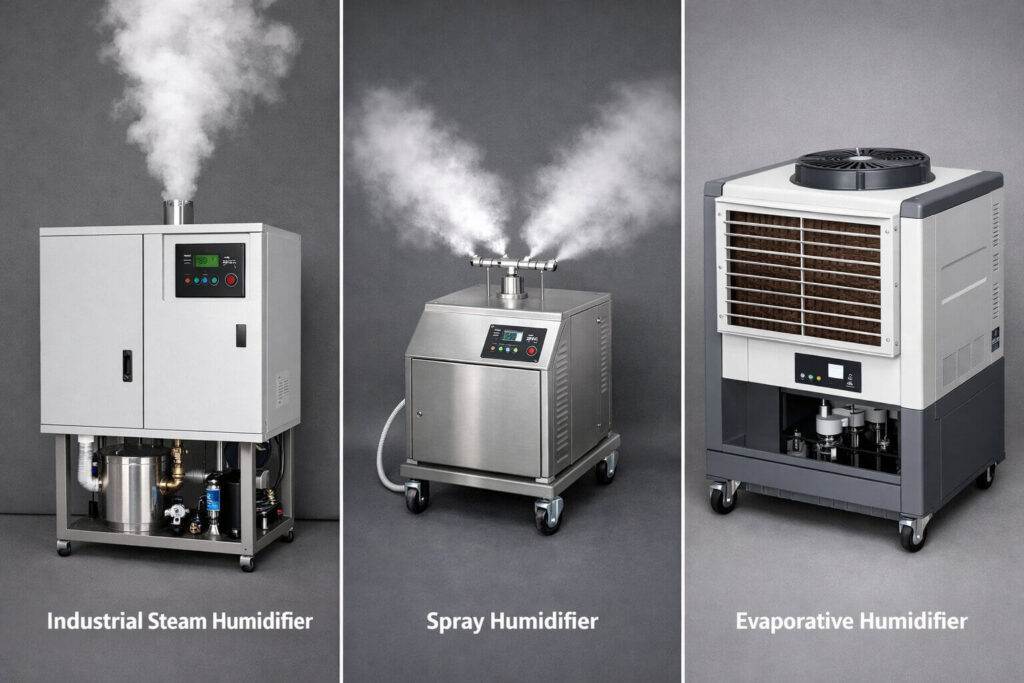
Evaporative systems work on a simple principle. Water flows over evaporator pads while air passes across them, picking up moisture in the process. At the same time, the air temperature drops due to evaporation.
These systems are popular because they come with low capital and operating costs. They are effective for both humidification and cooling, especially in large spaces.
Traditionally, cellulose paper pads have been used, but they degrade over time due to continuous exposure to water. To overcome this, many manufacturers and contractors now use PVC pads, which last longer and require less maintenance. Another more reliable option is a matrix made from glass fibre and china clay. This material is inorganic and can provide years of troublefree service.
Atomization and Adiabatic Humidification
In atomization-based humidification, water is introduced into the air as extremely fine droplets. This is achieved using mechanical atomizers or spray nozzles, often supported by pumps or compressed air.
Here’s the key idea. The water absorbs heat directly from the air to evaporate. This makes the process adiabatic, meaning it adds moisture while simultaneously cooling the air. In high heat-load environments, this cooling effect can reduce the overall demand on air handling units and allow for more efficient system sizing.
Air washers are a common example, especially in textile air conditioning in India. However, their effectiveness as humidifiers is limited. Only a small portion of the sprayed water actually evaporates. Most of their benefit comes from cooling, and they consume significant pumping power. When chilled water is used, air washers can cool and humidify at the same time.
Spray humidifiers, on the other hand, evaporate nearly all the sprayed water. Even then, they are typically used to supplement air conditioning, not replace it, even with chilled water.
Adiabatic humidifiers perform best in summer when the difference between dry bulb and wet bulb temperatures is high. In winter, their efficiency drops unless the incoming air is preheated.
Choosing the Right Technology by Industry
The right humidification method depends heavily on the application.
Pharmaceutical and healthcare facilities usually operate with smaller air volumes and strict hygiene requirements. For these environments, isothermal or steam humidification is often the preferred choice. It meets health and safety standards by eliminating microbial risks, and it aligns with World Health Organization guidelines, which mandate isothermal humidification.
Industries such as automotive manufacturing, electronics, explosives, and textiles deal with much larger air volumes. In these cases, adiabatic humidification can be more practical and energy-efficient. Modern systems reduce microbial contamination risks through technologies like silver ion–treated components or UV sterilization.
Humidity Control in Paint Booths
1. Water-Based Paint Applications
Water-based coatings are widely used in the automotive sector. To achieve consistent paint quality, relative humidity needs to be carefully controlled.
An RH range of 65% to 75% is ideal. This prevents excessive aerosol evaporation, supports uniform paint deposition, and avoids premature drying. Since paint booth air is typically not recirculated, humidification demand can be high in both peak summer and winter conditions.
2. Electrostatic Painting and Powder Coating
Electrostatic painting is driven by both economic and environmental benefits. It reduces overspray, improves material transfer efficiency, minimizes solvent use, and allows better particulate recovery. These advantages make it common in robotic, manual, and conveyor-based paint booths.
However, electrostatic processes are highly sensitive to humidity. If relative humidity is too high, electrostatic charging weakens and coating adhesion suffers. If humidity is too low, powder charging becomes inadequate, leading to poor transfer efficiency, uneven film thickness, higher waste, and even electrical arcing.
The sweet spot for electrostatic paint and powder coating is typically 45% to 60% RH, with temperatures maintained between 20°C and 25°C.
3. Dipping and Electroplating Processes
In multi-stage metal coating lines, components are frequently moved between treatment tanks. In hot and dry environments, low humidity can cause surfaces to dry unevenly during transfer. This leads to stains, defective coatings, and rework.
Maintaining relative humidity in the range of 50% to 60% prevents premature drying, reduces rejection rates, and saves both time and resources.