India’s air conditioning industry has traditionally focused on cooling and dehumidification. Heating and humidification rarely get the same attention. Outside of sectors like textiles, where high relative humidity is essential, humidification has often been treated as optional or ignored altogether. Many pharmaceutical plants built in the past didn’t factor in humidification during dry seasons.
That approach no longer holds up.
The Growing Need for Specialist Humidification Engineers
For years, India’s tropical climate and relatively mild winters made humidification seem unnecessary. But product innovation, tighter quality standards, and more advanced manufacturing processes have changed the picture.
Many industrial zones are located far from coastal regions, where ambient air becomes dry not just in winter but also during peak summer months. As companies build new facilities or upgrade existing ones, they usually rely on standard HVAC consultants. The problem is that humidification isn’t a plug-and-play add-on. It’s a specialised discipline that combines psychrometrics, process understanding, and real-world operating experience.
Most HVAC designers are not trained to design humidification systems.Selecting the right humidifier depends on the application, regulatory requirements, and the target room design condition.
Effective humidification design starts with understanding ambient dry bulb temperature, minimum absolute humidity, and the desired indoor conditions. These must be analysed using a psychrometric chart. Without a solid grasp of psychrometrics, errors are inevitable.
One critical point is often missed. Humidification capacity depends entirely on the volume of fresh air introduced by the air handling unit. It has nothing to do with room size, total airflow, or internal heat loads.
Understanding Humidification Methods
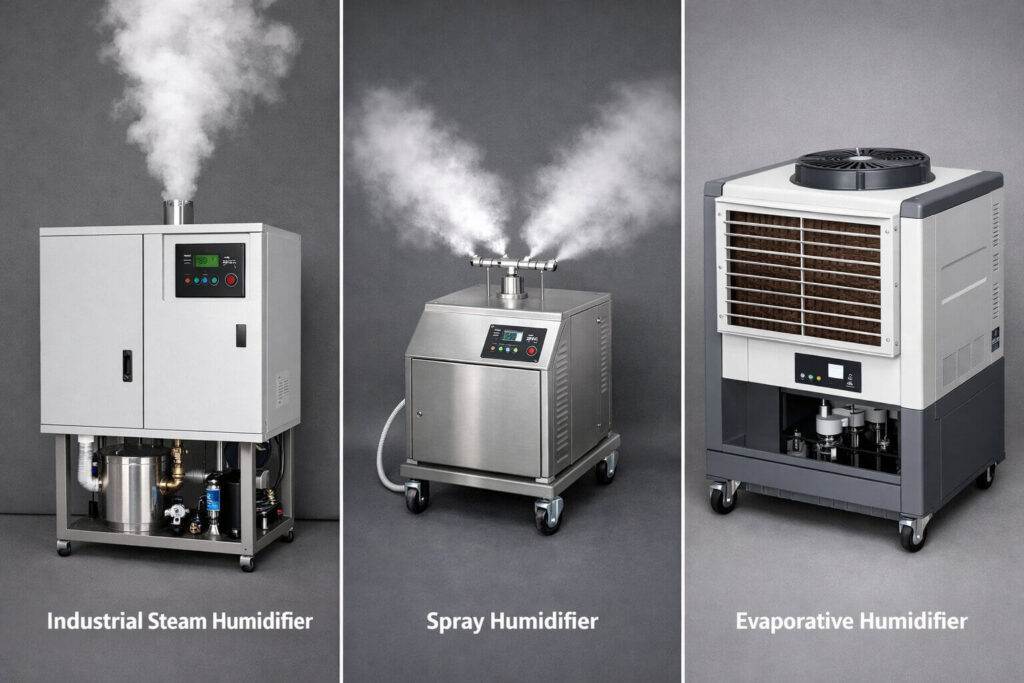
Humidification can be broadly classified into three physical processes: vaporization, atomization, and evaporation.
Vaporization is an isothermal process, meaning moisture is added without changing air temperature. Atomization and evaporation are adiabatic processes, where moisture addition also results in cooling.
This article focuses on isothermal humidification.
Isothermal Humidification Explained
Isothermal humidification raises the moisture content of air while keeping the temperature constant. Steam is the most common medium used to achieve this. Boiler steam is generally avoided as it can carry contaminants, so steam humidifiers that generate clean steam using electrical energy are preferred.
On average, producing one kilogram of clean steam electrically requires about 0.75 kW of power. Steam can be generated using resistive heaters, or for higher capacities, by using boiler steam as an energy source to generate clean steam indirectly.
For any steam humidifier to work effectively, the steam must be fully absorbed in the air. This depends on correct sizing and placement of steam distribution pipes inside the AHU or duct. Calculations must account for air conditions and the physical geometry of the air handling unit. Poor design leads to condensation, wet ducts, and unreliable humidity control.
The Role of Humidification in Pharmaceutical Manufacturing
In pharmaceutical production, humidity control isn’t optional. It directly affects product quality, safety, and compliance.
When relative humidity drops below 45 percent, static electricity becomes a serious issue. Static can disrupt production, damage equipment, and compromise packaging. It also carries a risk for personnel operating equipment.. Consistent and reliable humidification equipment is essential to avoid these risks.
Budget Choices and Their Real Cost
Commercial teams often push to minimise capital expenditure and choose the cheapest control systems available. What this approach ignores is operating cost, maintenance effort, and the risk of production losses.
In pharmaceutical manufacturing, a single batch can be worth millions of rupees. Investing slightly more upfront in a high-quality humidification system often pays back quickly through lower maintenance, stable operation, and reduced risk of batch rejection.
Why Humidification Is Needed Even in Summer
Air handling units typically introduce five to ten percent fresh air to maintain room pressure balance. During summer, outdoor moisture levels are often lower than required for controlled environments. Without active humidification in the AHU or supply duct, indoor relative humidity drops below acceptable levels.
Cleanrooms and Process Sensitivity
Cleanroom manufacturing demands tight humidity control.
In tablet processing, incorrect humidity after coating can damage product characteristics. Capsule manufacturing and filling typically require around 50 percent RH. If humidity is too low, capsules become brittle. If it’s too high, they turn sticky and difficult to handle. High-speed capsule machines perform reliably only when relative humidity remains stable.
Stability Testing Requirements
Regulatory stability testing requires humidity to stay within ±5 percent RH. Falling outside this band means retesting, which is expensive and time-consuming. In some cases, it can delay product approvals and market launches.
Preventing Static Electricity
Static build-up becomes significant below 40 percent RH. This affects both production and packaging and poses serious risks in electronics manufacturing or when handling flammable materials. Maintaining humidity in the 45 to 55 percent RH range helps prevent electrostatic discharge and improves overall process safety.
Approved Humidification Solutions for Pharmaceuticals
The World Health Organization prohibits adiabatic humidification in pharmaceutical environments due to contamination risks. Only steam-based humidification is permitted.
These systems must be designed to drain completely, avoid condensate formation, and eliminate downstream filters where microbial growth could occur.
Electrode vs Resistive Steam Humidifiers
Electric steam humidifiers are generally available in two types: electrode and resistive.
Electrode humidifiers generate steam by passing electrical current through water. Steam output varies with water conductivity and level. Mineral concentration is controlled by periodic draining and refilling, allowing humidity control within ±5 to ±7 percent RH. These units have lower initial costs and are easy to install but require regular cylinder replacement due to limescale buildup.
Resistive humidifiers use heating elements to boil water. Steam output is independent of water conductivity, making them ideal for use with RO water. This reduces scale formation and maintenance while enabling precise humidity control of up to ±2 percent RH. Although resistive systems cost more upfront they need very little maintenance. The stainless-steel cylinders are cleanable, spare parts costs are lower, and long-term operating expenses often justify the investment.